Wednesday, March 14, 2012

Lao Sze Chuan


Before we get to the main topic of this posting, I have a couple of housekeeping notes to pass along. First, I discovered this past Saturday afternoon that the good people at Three Floyds Brewing Co. in Munster, IN not only continue to produce microbrews that put the majority of the civilized world to shame (I had the pleasure of sampling the Admiral Nelson Extra Special Bitter, the Topless Wytch Baltic Porter, and the Hell's Black Intelligenser Coffee Stout, all fantastic), but can also whip up a mean smoked lamb platter even while undergoing major renovations (the kitchen was completely closed - in its place, just a grill and a smoker operating under a tarp outside). Secondly, I made a return visit to Eleven City Diner (where I procured a nice chocolate milkshake on foodie walkabout last October) for lunch today and got to try the house smoked brisket sandwich (called the "Schwartzy" in obvious homage to the home of the most famous smoked brisket, Schwartz's Deli in Montreal), which was tremendously good (and saved me the airfare to Canada).

This brings me to tonight's headliner - Lao Sze Chuan in our fair city's Chinatown neighborhood on the near southwest side. Restauranteur Tony Hu is quickly becoming a well-known figure in the local culinary scene, having recently opened his 5th venture in Chinatown. Each of his places focuses on the cuisine of a distinct Chinese region (Szechuan, Beijing, Shanghai, Hunan, and You Ju), with Lao Sze Chuan (LSC) being his first (open since 1998). I had heard many good things about LSC's offerings and have made woefully few trips to Chinatown during my long tenure as a Chicago resident, so Mrs. Hackknife and I finally decided to see what all the hullabaloo was about. Our foodie friends Phil and Karen V. kindly agreed to join us, making it a couples night out without the kiddies (not too late, though - daylight savings time was looming at 2 am, waiting to steal away an hour when the clocks moved forward).

I made a halfhearted attempt to get us a reservation a few weeks in advance, and by halfhearted, I mean that I spoke on the phone to a hostess who told me in broken English to call 20 minutes before our arrival to presumably get our names on the waiting list (at least, this is what I think she said). Anyway, a persistent busy signal prevented us from making further contact on our drive up, so we simply waited our turn outside the storefront along with the other anxious masses. After about 30 minutes of listening to the Chinese maitre 'd scream out waiting list names (his voice was possibly better suited for a cattle auction) and watching one instance where I swear he let a group of natives from the Fatherland in ahead of everyone else (they had a brief exchange in Mandarin and he slipped them a little pink paper with some scrawled characters - it was all very clandestine), we were seated just inside the main doorway.

Now, you may be aware that szechuan food has a reputation for being a little heavy on the spice - as a result, I think we were all a bit wary about what we might be getting from the kitchen. Our group decided to order a mix of dishes from the "spicy" and "non-spicy" options listed on the house special menu page (there were many more pages of available dishes, which we mostly ignored this time out) to hopefully cover a broad swath of LSC's best-known offerings. Our server first brought out a little plate of white cabbage spiked with red chilis (you can see it in the upper right corner of the photo at top). This dish was complimentary and was possibly intended to be a palate cleanser, although I would describe it more like a palate carpet bomber as it was stunningly spicy. While I waited for the feeling to return to my lips, I started to worry that perhaps we had gotten a little more than bargained for with respect to the heat, nervously glancing at other tables to see if anyone else has polished their cabbage off (some did, some didn't). Phil theorized that the staff used this plate as a spice benchmark for each table, watching to see who avoided it, then adjusting the heat content of the subsequent dishes accordingly. He may have been onto something as our other food items were all pretty tame in comparison (apparently, we failed the test).

I must give credit to Nick Kindelsperger of Serious Eats Chicago, who recommended 2 LSC dishes in an article he wrote back in January, both of which (Tony's three chili chicken and the string beans in a spicy black bean sauce) were unbelievably good. Many food bloggers have described the three chili chicken as being addictive and I can see why - try to imagine the endorphin rush from the best General Tso's crispy chicken that you've ever had and multiply it by 10. The fried chicken pieces were wonderfully crisp, not the least bit greasy, and were perfectly balanced between sweet and spicy. Our last dish from the spicy portion of the menu specials was a platter of what was described as twice cooked pork fat (with the word "fat" listed in parentheses - we never really figured out why). This one appeared to feature thin slices of fatty pork mixed with roasted peppers, mushrooms, and corn (it's the red, green, and brown pile featured in the lower right corner of the photo) and was the group's least favorite of everything we ate that night (still not bad, but not all that distinct from what the cheap Chinese take-out joint in your local strip mall is churning out).

As for the non-spicy dishes, we picked an amazing crispy shrimp in mayonnaise sauce (easily the best honey-type shrimp dish I've ever eaten at a Chinese place) and an equally impressive Szechuan smoked tea duck served on the bone with an addictive (there's that word again - are they mixing heroin into the MSG shaker back there?) dipping sauce. By the time we had picked apart the last piece of duck and swallowed down the final crispy nuggets of fried chicken/shrimp, the 4 of us took our fortune cookies and headed back south feeling mightily content and heartily smelling of wok oil. I'd say we were all pretty satisfied with the experience and can hardly wait to try another of the restaurants in the Tony Hu empire. I continue to feel this way even after waking up at 4:30 that night (it would have been 3:30 the previous night, but clock changing be damned, I had more pressing issues to endure) to rush to the bathroom, clutching a box of Immodium while pondering death on the toilet like Elvis. I don't know if it was the extra duck drumstick or the third helping of three chili chicken that put me over the edge, but I think my ever-weakening stomach is warning me not to mix microbrewed beer and spicy Chinese food on the same day again...

Friday, March 9, 2012

Burger 'N Que


A hearty thanks goes out to Friend of the Blog (and fellow foodie) Karen V. for cluing me in to a local burger joint that's been long overdue for a visit. If you're driving up Wolf Road in the far reaches of Orland Park, you'll notice a gas station on the left right after you pass the light at Southwest Highway. Sharing the lot with the gas station is a small, relatively nondescript building that looks as if it could have been a convenience store at one point. The tiny diner located within, Burger 'N Que is one of those places that, as a local, I've passed a hundred times without ever really noticing that it's there (let alone stopped in). It surely would have remained that way if not for the effusive praise Karen gave it on Facebook one evening - something about jalapeno bottle caps particularly caught my attention and I made a mental note to add it to the ever-growing hit list.

I picked a Thursday morning before the lunch rush not long ago as the best time to try it out, with Hackknifette accompanying me for moral support (she was hoping to get some lemonade out of the deal). The lot in front of the restaurant was full (even at 11:30), so we parked in the muddy, unpaved area off to the side and sauntered in. I was immediately struck by how little space there was inside, with room only for a counter, kitchen, restrooms, and a couple of booths/tables. A few people were milling about waiting for their orders to arrive; otherwise, I'd describe the vibe as sedate, with the decor consisting of signed photos from local celebrities (such as Hungry Hound Steve Dolinsky), a 50s-era auto racing design scheme, and a tv blaring Jerry Springer in the corner. Clearly, there wasn't much to focus on than the cuisine, which is fine in my book when the food is good like it was here. Hackknifette opted for the kid's cheeseburger with fries (and, yes, she got her lemonade) while I tried 1/2 lb. Bernie burger (see photo above), served with grilled onions, American cheese, a house sauce eerily similar to thousand island dressing, all on a crusty French roll (fries came with my order as well - I was hoping to get the black and tan onion rings I saw on the webpage menu; alas, they're not listed at the restaurant). My burger was great, juicy and a little sloppy in the way I like my short-order burgers to be. The roll was a bit toothsome and the fries were just ok, but the house gets extra points for having Barq's Red Cream Soda available (a favorite of mine from college that I don't often see anymore). I'd have to give a slight edge to Top Notch Beefburger in Beverly with respect to my ultimate South Side burger; however, the offering at Burger 'N Que was more than adequate and a much closer trip from the Commissary. I'm sure we'll be making a return visit to sample the pit bbq brisket and also to get some of those mysterious jalapeno bottle caps...

Wednesday, March 7, 2012

Sweet & Sour Sardines

As a general rule, Americans (at least those without predominantly Northern European bloodlines) tend to shy away from small oily fish. This certainly was the case during my childhood, where eating an anchovy was considered only marginally preferable to covering one's naked body with maple syrup and belly flopping onto a fire ant mound. Indeed, even as an adult, I wouldn't have given pizza with anchovies a second thought until I met the great Mrs. Hackknife, who convinced me that the idea had merit, and, by golly, she was right! The humble, salty anchovy proved to be a gateway to other tiny swimmers - I no longer feared herring, smelts, or sardines, even willingly seeking them out at times, sold on the rich, dense flavor and the well-documented health benefits. This leads me to our featured recipe, which is included in the current (March 2012) issue of Saveur in an article on Venetian "cicheti" (essentially one-bite bar snacks). Of the dozen-odd dishes presented, one of them (sweet and sour sardines) stood out to me as being 1) easy to prepare, 2) enticing to Mrs. Hackknife, 3) a good companion to pesto pasta (yes, that same pesto left over from my earlier gnocchi disaster), and 4) full of several ingredients already in the larder (e.g., white wine, raisins, olive oil, pine nuts).

My initial challenge was getting the sardines. The recipe listed 2 lb. worth - if that seems like a lot to you, you'd be right. At first, all I could locate were canned sardines, which were quite expensive if you bought 2 lb. of them (each tin held about 4 oz., meaning I would need 8 tins at $3/tin, well, you get the picture). Luckily, the deli at my local ethnic grocery offered sardines packed in salt for about $8/lb. - even then, I stopped at only a pound after I realized that still gave me about 12 decent-sized fish (each about 4 in. long). Bringing my quarry home, I had planned to whip the dish up right before dinner until by chance I noticed the text "marinate in refrigerator for 4 hours" appended onto the very end of the recipe, which caused me to launch into a flurry of panicked activity between lunchtime and picking up Hackknife Jr. from school in order to get my fishies prepped and into the fridge. Really, all parts of the process were simple, with one exception - cleaning the sardines. Since they were salt packed, I followed the Ruhlman technique of soaking them in milk for 30 minutes to remove the salt crust. Next, like anchovies, I figured I'd need to slice each sardine open to remove the backbone and, hopefully, many of the smaller pin bones at the same time. Unlike anchovies (which are smaller), I discovered that sardine backbones are much more embedded and, therefore, harder to remove without breaking into pieces (and as for the small bones, forget it - they all mostly stayed behind in the flesh). Still, the picture of the finished dish in my magazine clearly shows pin bones protruding from the fish, so I pressed onward unconcerned.

Now we get to my main epiphany, revealed after broiling the semi-deboned sardines in a hot oven for 3 minutes - they're exceedingly oily. And this oil is, shall we say, incredibly pungent, leaving behind a persistent, smelly trail wherever it makes contact, even after repeated cleaning. For days afterwards, my sink, towels, cutting board, and hands carried a faint, oceanic odor that was readily apparent anytime someone wandered by the Commissary (Ed. note - for those of you readers in the Taliban, I daresay that sardine oil would make a far better dirty bomb material than plutonium, with its stink rendering any city completely uninhabitable for centuries). Despite its olfactory condition, the marinated, chilled sardines looked pretty much like they did in the article photo. I would characterize their taste, however, as very salty, maybe overbearingly, high blood pressure-inducing salty (perhaps 30 minutes more in the milk bath were needed). And although the pin bones are edible, I wouldn't exactly describe them as pleasantly so. Mrs. Hackknife and I both agreed that the dish worked on principle, but the salt/bones really detracted from the experience and pretty much overwhelmed the flavor of the pesto pasta (which is usually strong on its own). I suspect that in more capable hands (especially someone who knows how to properly fillet small fish), the end result could be much more balanced and appealing. Perhaps some reconnaissance to Venice is needed to sort these issues out....

Monday, March 5, 2012

Forloren Hare (Danish Meat Loaf)

After my gnocchi debacle the other night, I was in some serious need of redemption and I found it in the comforting form of meatloaf. The January/February 2012 issue of Saveur listed meatloaf as one of a select 100 "new classics" (whatever that means exactly) and included recipes for several versions of it, one of which caught my eye more than the others. Listed in the article was a variety of meatloaf from Denmark called forloren hare (literally "fake hare" or "mock hare" in Danish) that includes a mixture of beef/pork, some heavy cream, a rich gravy, and strips of bacon over the top to help retain moisture during baking (apparently, those Danes know how to indulge themselves). Now, we already have a house meatloaf recipe that's pretty well received (courtesy of my mother-in-law) - it also happens to include a beef/pork mix, but not any of the other goodies I listed. So, as a change of pace, I decided to give our mock hare a try in the Commissary.

All of the ingredients were procured pretty easily (I had to go to my local ethnic grocery to find some red currant jelly) and the dish's assembly was not tricky at all. I ended up using about 6 slices of thick-cut bacon to cover the loaf before putting it into the oven on a cookie sheet lined with parchment paper. While it was baking, I whipped up the gravy on the stovetop (I believe this was my first ever gravy made from scratch) and was quite surprised at the decadent result from cooking down caramelized onions, beef stock, the jelly, some flour/butter, a little thyme, and a bay leaf. Although the recipe called for straining the gravy to remove all of the solids, I couldn't resist taking a couple spoonfuls of the filtered debris (which was loaded with those awesome browned onions) and mixing it back into the gravy liquid to kick it up a notch.

The meatloaf came out of the oven not looking all that great (hence the lack of a picture in this post), but the flavor was a knockout, with Mrs. Hackknife and I both swooning (and completely forgetting about the weekend's earlier failures). The progeny were content to nibble on the bacon portion of the loaf, which I consider to be a vote of confidence from that crowd. All told, it blew away our house version of meatloaf, not surprising considering the rich contents. If the local county fair had a contest to judge baked meat structures, the forloren hare (I would have to rename it "Danish Beauty" for marketing purposes) would definitely be my blue ribbon submission. Unfortunately, the extra fat from the bacon/gravy/cream did a number on my insides for 12-24 hours after the fact, so we'll have to save this recipe for special occasions and holidays for now on, sticking to the old, blander standby for our habitual meatloaf...

Friday, March 2, 2012

Gnocchi alla Romana

If you're a frequent reader of this blog, you know that my track record with new recipes significantly varies. A few of them are home runs, lots fall in the mid-category range of being decent, but not necessarily warranting a repeat appearance, and every now and again I come up with a real clunker. My recent attempt at making semolina-based gnocchi (aka Gnocchi alla Romana) falls into this last category, a spectacular, unmitigated, nearly-inedible disaster. How did we get here, you say? Well, I'll try to conduct an adequate post-mortem.

I've had a 2-lb. bag of semolina wheat sitting in my spice/baking cabinet for nearly a year now. I went out and purchased it soon after my original mediocre attempt at making gnocchi last year (this one was potato-based - see February 2011 posting). With Lent having just arrived and the bag's expiration date fast approaching, I decided that last Friday was the perfect time to finally try out the semolina gnocchi, in theory an ideal meat-free dish for us (semi-)observant Catholics. The recipe in question Gnocchi alla Romana comes from my oft-used April 2010 issue of Saveur featuring Roman cuisine (you'll recall that I've had much success replicating dishes from this article up until now). Upon reading the instructions, I didn't anticipate any hangups and set off pretty confident in my abilities to pull this one off like the others.

Almost immediately, I hit a major snag. The recipe calls for 1 1/2 c. of semolina, or 8 oz. Now, I would assume that most normal, thinking folks would read that and say "Boy, that must mean the 2 measures should be roughly equal". I may not be considered normal or a thinking folk, but, in any case, that's at least what I thought. Perhaps the fact that one measure is a volume (c.) and one measure is a mass (oz.) should have led me to be a bit more cautious in double-checking my ingredient outlay. Anyway, when the milk started simmering and I added my 1 1/2 c. of semolina, I was shocked to discover that my pot became an unstirrable (is that even a word?) morass of glop, with the material inside unable to be moved by whisk, wooden spoon, or jackhammer. It was almost as if I had added too much semolina. Hmmmm. It was then that I glanced at my bag of semolina to note that it was half-empty. This is when the math gears in my mind began whirring....2 lb. is 32 oz.....half of 32 oz. is 16 oz......1 1/2 c. of semolina is 16 oz.). Why, I had used twice as much semolina as I was supposed to! Was this semolina somehow a super-dense version previously unknown to mankind? I cursed myself out for not noticing this discrepancy at the beginning and tossed the whole mess in the garbage (I must admit it wasn't a total loss - it actually smelled nutty and rather pleasant as garbage goes, even after a day or two).

At this point, convinced I had solved the problem, I started again, this time using the correct amount of semolina (3/4 c. or 8 oz.). All went well until it was time to cut up the solidified, dried gnocchi dough into 2" squares. The mixture looked good when pored onto my cookie sheet and seemed to have the right consistency, but after the recommended 40 minutes of downtime, I cut into....glop, a soggy, loose, wet mess that barely held any shape. This couldn't possibly be right, could it? Now I was really in trouble. I had already lost time after my initial misfire, the kids were hungry, Mrs. Hackknife was about to walk in the door expecting to find a hot, hearty dinner, and I've got Malt-o-Meal. I put on a brave face and tried to finish out the recipe, using a spatula to scoop the very-runny dough squares into my baking dish, loading them up with cheese/butter, throwing them into the oven, and hoping for the best. The best never arrived. My completed gnocchi landed on the plates looking like bad polenta and tasting worse than that. Even our well-loved house pesto sauce (which I would gladly apply to my own gym shoes if for some reason they were the only thing around to eat) couldn't rescue this. Mrs. Hackknife stopped after a couple bites and murmured something about take-out pizza. The progeny? Forget it. I soldiered through a first and smaller second helping, then promptly tossed the remainder to join its unborn sibling at the bottom of the trashcan.

I want to believe that the dough simply needed extra drying time to harden, but I'm not entirely sure that's true. After this and the prior unsuccessful experience, I'm starting to think that gnocchi just might not really ever find a place in my recipe box (I don't even really like eating it that much, so I won't shed any tears). From now on, I'll leave the gnocchi making to my Ohio relatives (who can turn out a mean batch of the stuff) and our local Italian restauranteurs....

Wednesday, February 29, 2012

Mexican Green Bean Salad

This concoction isn't nearly as bad as it sounds. In fact, I have to say it packs a flavorful punch for a dish that wouldn't be out of place in a vegetarian version of a Betty Crocker cookbook. But I'm getting a little ahead of myself - let's rewind for a second. We have taco night at the Commissary about once a month. Our house tacos usually consist of seasoned ground turkey meat (or leftover roast chicken pieces if I'm feeling saucy) and the usual Middle America toppings of shredded cheese, lettuce/tomato, sour cream, and taco sauce (mild, of course), all plopped in the center of a warm flour tortilla. The progeny typically take their tacos deconstructed; that is, with the cheese and tortilla in separate piles (and mostly dismiss those other ingredients as beneath their sensibilities). Anyway, I digress. I'm constantly seeking adequate vegetable side dishes to go with the tacos - oven-roasted green onions or bulb onions (cebollitas) seem to work pretty well and there's always the ever-present bag of frozen broccoli/cauliflower, but I wanted something different for a change this latest iteration.

I thought back to when Mrs. Hackknife and I dined at Big Star last year and I remembered really liking the braised long beans that were included as part of my ejote taco, so why not come up with a similar bean recipe that has a Latino flair? A quick Internet search using the most generic terms possible ("Mexican" and "green beans") turned up this Mexican green bean salad recipe from the Simply Recipe website, which credits it as a variation on Diana Kennedy's cactus salad from The Art of Mexican Cooking. The recipe is really easy and works well with generic, store-bought fresh green beans. I omitted the pickled jalapenos and used more of a queso fresco instead of the cotijo cheese. The red onion and cilantro give the dish a nice bite, with the avocado and cheese adding richness and the lime juice providing acid to cleanse the palate. If you're careful to slightly undercook the beans (about 5 minutes in boiling water, then spray with cold water after draining), they'll be just a little crunchy in the finished salad.

Monday, February 27, 2012

Next el Bulli Tribute - Installment 3

After the levity of the mullet-on-seashells course, the proceeding dish was a shining example of perfect simplicity, an intersection of French and Japanese tastes: a thick disc of eel atop a decadent slab of bone marrow, under which rested a dark green nasturtium leaf shaped like a lilypad. Another nasturtium leaf held a circle of fresh cucumber and between these two leaves was a beautiful red-orange nasturtium flower.


These flavor combinations were an incredible match, with the peppery leaves and the clean cucumber cutting the richness of the eel and marrow. I have a difficult time describing the taste of the flower, however; that is to say I recall it being relatively bland, bringing to mind images of goats munching on shrubbery. The alcoholic beverage pairing with this course was an amazing beer, another collaboration between Next and local favorite brewery Half Acre. For the Thai menu, Half Acre used hibiscus as the dominant ingredient in the collaborative beer; this time, oranges and beets featured prominently, resulting in a surprisingly smooth, red ale-like quaff called Sanguis (a reference to the dark red "blood" color of the beer, no doubt from the beets). The brew was a great accompaniment for 3 courses and eminently drinkable by itself (indeed, the waitstaff was gracious enough to let us buy 4 bottles of the stuff to take home, one of which has already been enjoyed at the Commissary).


Next up was a curious plate - a civet of rabbit served with two small cubes of hot apple jelly and diagonal smears of beige and maroon sauces. After some discussion at the table, we came to a general agreement that the beige sauce was liver-based, possibly foie gras. There was no consensus about the maroon one, other than it was clearly meant to evoke blood (nicely matching the beer, of course). Regardless of what they were, everything on the plate was mind-bogglingly delicious.


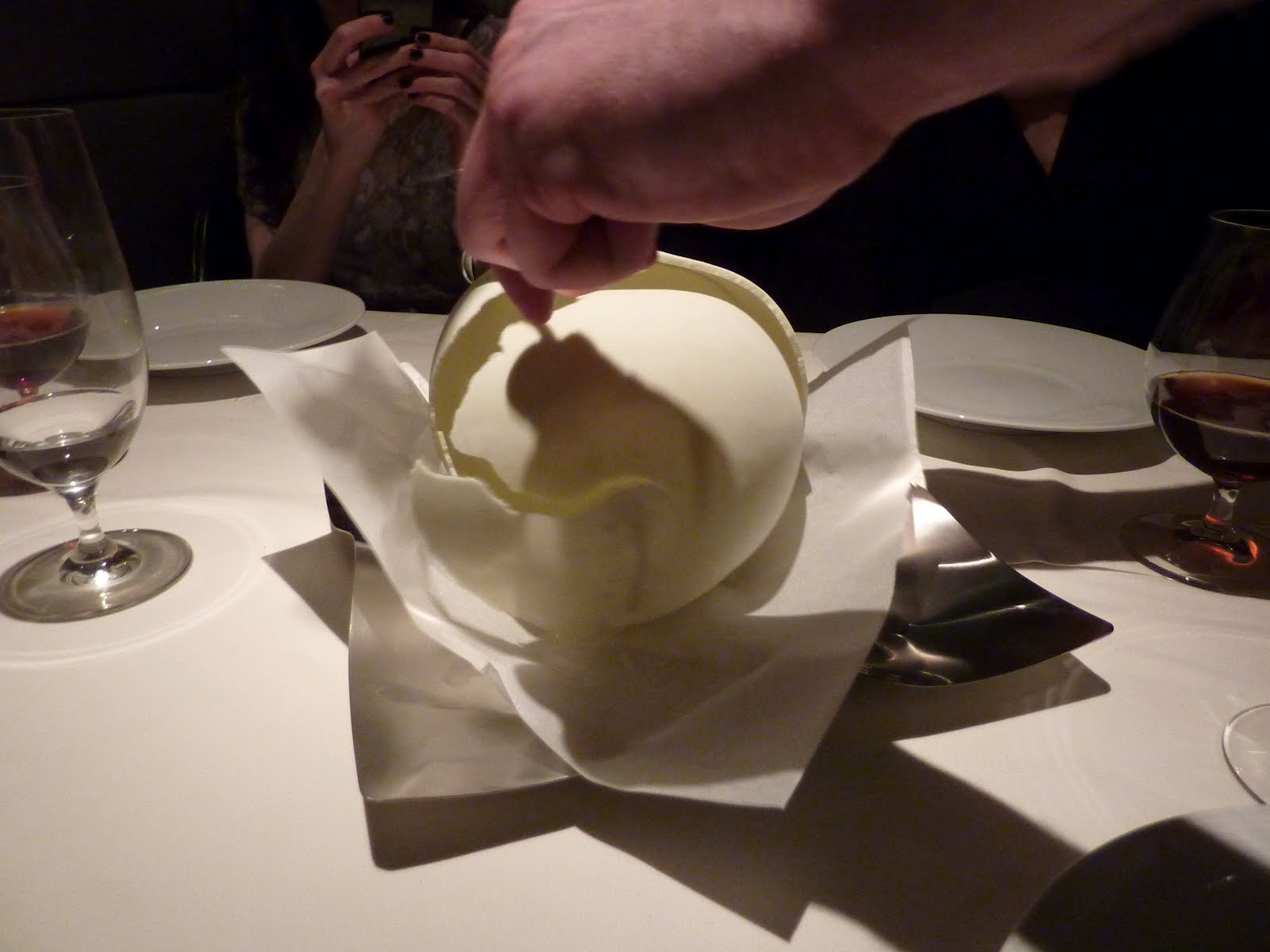
I had to look up "civet of rabbit" back home and discovered it to be an old French dish (also popular in England) whereby rabbit meat is cooked in red wine vinegar plus a brandy sauce that's enhanced with the rabbit's liver and blood. Upon further reflection, then, it seems clearer to me that the "smears" in question were probably rabbit liver (beige) and rabbit blood (maroon), a deconstructed brandy sauce from the traditional recipe (although I'm just speculating at this point). The meal headed back to the funhouse with the following course, a dinosaur egg-sized hollow sphere of a white material that turned out to be blue cheese (the menu lists gorgonzola, but I've read at least 2 published reviews stating that it's actually Maytag Blue from Iowa). Our server cracked the sphere with a flourish and offered each of us pieces for nibbling.


The cheese was delectable, but it was robust and there was a lot of it, much more than the table could eat at this juncture of the meal. In fact, I'd be surprised if any of the diners were able to polish off the whole thing (Chef Beran could probably reduce the sphere's size by half and not really lose anything in the process). From a technical standpoint, this was another of those "how'd they do that?" courses. Liquid nitrogen was definitely involved (the cheese was frozen and started melting fairly quickly) and some sort of scaffolding on which to mold the raw material; beyond that, I'm clueless to its genesis. From this point onward (after the cheese course, naturally), our journey began to nudge ever-so-slightly towards sweeter and less savory plates, starting with a wonderful flan-like caramel custard of foie gras (the ultimate sweet/savory pairing) accompanied by a second palo cortado sherry (this time a Lustau "Peninsula").


This was followed by another whimsical course, a little game to see how well one's palate could identify various spices. A bowl filled with a light green gelatin (neutral tasting, maybe green apple?) suspended 12 different flavorings, each neatly placed at the hour positions on a clock face. The goal was to match up each spice (listed on a separate card) with its corresponding clock position in the bowl. Some of them were easily recognized by sight (such as mint leaf and saffron threads), while others were more difficult to distinguish (pink peppercorn versus Szechuan pepper). All things considered, Mrs. Hackknife and I did pretty well, correctly identifying the placement of 9 out of 12 spices. We enthusiastically washed down our gameboard with a nice Pommeau de Normandie (cider mixed with apple juice) that had some white tea, lychee, and mandarin orange added for complexity.


I'd gotten a little bit of advance intel regarding the next dessert, described on the menu as a "mint pond", basically a thin, frozen layer of water onto which our server sprinkled mint, brown sugar, and green tea. We were instructed to crack the ice with a spoon (this was a bit messy, with ice chunks popping around the table) and mix the shards with the spices, creating a very simple and tasty dish not entirely unlike what my mother-in-law likes to make at the Commissary in wintertime for the kids using freshly-fallen snow and whatever sweet liquid (juice, maple syrup, etc.) happens to be around (or is it more like the ice cubes at the bottom of the soft drink cup that you chew on?).


When Jose Andres spoke to our group at the Cayman Cookout, he made reference to a technique he'd learned (possibly at el Bulli) to flash-freeze the top layer in a bowl of water and drain out the remainder via pinhole, leaving the hollow frozen layer on top. This came to mind as I scrutinized the serving vessel, but I wasn't able to find any obvious escape route for liquid underneath the top. Maybe the "pond" was frozen in a different mold and then fitted to the serving vessel or maybe a different sleight-of-hand technique was in play - I can't say for sure. A dessert course attributed to Albert Adria (Ferran's pastry chef brother) immediately followed, an elegant-looking plate evoking a sea fan or coral whose components were a diverse collection of chocolate textures and tastes.


Being a huge fan of chocolate in any form, I was pretty pleased with this creation and the smaller sweet bites that came next: chocolate "donuts" that were actually frozen discs of coconut creme dipped in dark chocolate, paper-thin pastry flutes stuffed with whipped cream, and puff pastry "webs" that resembled twisted pretzel dough.


None of these items on the table survived for long. Our final drink pairing (which was served with the dessert bites and the previous chocolate course) was a unctuous Casa de la Ermita "Dulce Monastell" dessert wine from the Jumilla region of Spain. By this time, the overall experience had exceeded the 4-hour mark and everyone at the table was starting to get a little weary. As much as I wanted to tour the kitchen (I'd missed out on my previous 2 visits), Mrs. Hackknife and I decided to defer to of one of the later menus (Sicily in June and Kyoto in October) so we could get home to cut the babysitter loose. As we prepared to depart, our server brought us one more course, a bit of parting theater in the form of inflated white rubber gloves stretched over the openings of small silver bowls. Inside one of the bowls were the el Bulli version of the after-dinner mint, a handful of passionfruit marshmallow candies.


As you can infer from the photo, the idea at hand here (sorry...awful pun) is that the gloves "wave goodbye" as you tap the bowls, which was a fine encapsulation of the whole meal: gestures somehow both refined and casual, executed time and again in perfect balance. Of course, not every course struck a positive chord with me, but as a complete entity, the experience certainly satisfied whatever longing I had to dine at el Bulli (without having to leave my fair city, to boot). I have to commend Chef Achatz, Chef Beran, and all of the staff at Next for having the confidence to take on such a daunting challenge and the technical skill to flawlessly pull it off. I can hardly wait to see what the boys whip up for the next 2 menus and feel incredibly fortunate to have the opportunity to be a regular patron of their temple to world cuisines....