Sunday, September 15, 2013

Puerto Rico Dining - Day 3

Mrs. Hackknife and I had another excursion scheduled on the morning of our third day in Puerto Rico, this time a walking tour (more history than food-focused) through the streets of Old San Juan. Since I can't appreciate history on an empty stomach, we popped into a coffee shop that Paulina and Gustavo had recommended for a quick breakfast. The coffee shop (Cafe Don Ruiz) is situated on the ground floor of the Cuartel de Ballaja, an old military barracks (see photo below) that has now turned into a museum and a dramatic public space for performances like classical music (we saw several groups of musicians practicing outside that morning).


Inside, the coffee house has an abstract modern decor that's very different from its host venue. They offer a modest selection of baked goods to go with what I was told was exceptional coffee (according to the missus). We opted for a pair of scrumptious-looking alfajores (see photo below), a sweet from Argentina consisting of two butter cookies sandwiched together by a layer of dulce de leche (which, apparently, is like catnip to Argentinians), then rolled in coconut and (soemtimes) topped with chocolate.


We also tried another Puerto Rican specialty called quesitos, small baked pastry shells filled with cheese. These were a little dry and not as good as the alfajores.


Following our walking tour (which was conducted by an American expat artist now living full time in San Juan), we continued walking down Calle Sol until we passed a sign for the Mezzanine at St. Germain, featuring a tapas brunch on weekends. Taking the bait, we wandered upstairs (the main restaurant, a French bistro, is on the ground floor) into a small, tastefully-decorated dining salon, where we were served a couple of stiff cocktails (whiskey lemonade and bloody mary) before receiving our tapas selections. First up were plates of brie and prosciutto on baguette and bagel pieces with salmon spread, dill, and horseradish:


Even better was the following pair, a knockout chickpea-and-grain escabeche (escabeche differs from ceviche in that the main ingredients are cooked, not raw, when mixed with the acids) served with crispy chips (Mrs. Hackknife and I fought over the remnants) and tuna tartare on cucumber slices:


Last, but not least, were toasted croissant slices filled with guava jelly and brie (a much better version of the quesitos we had earlier) and sweet/tangy meatballs topped with sesame seeds (reminding me of the burgundy meatballs that my mom sometimes used to make for parties):


With lunch out of the way, we were free to do a little exploration of the city on our own, visiting both the Castillo de San Cristobal (one of the two historic citadels that protected San Juan from marauders) and the local Supermax, not a prison, but a grocery chain in Puerto Rico. I can't convey how much I enjoy going into supermarkets in exotic locales - it's a great way to discover staples in other cultures, like these:


Puerto Ricans are gaga for small, chewy candies containing coconut, pineapple, sesame, or other tropical ingredients. We also saw a lot of the mayo-ketchup dipping sauce in restaurants around town (which, as you might expect, is pretty much the same as Thousand Island dressing) and decided we needed to have some in the Canteen. The green bag of chips that you see was a mixture of fried yuca, plantain, and chicharron (fried pork skin) pieces that put your standard bag of Cool Ranch Doritos to shame. Last, but not least, we were hoping that the progeny would enjoy some local cookies called Ponky (more like little vanilla snack cakes covered in chocolate, made by Colombina, a Colombian-based manufacturer), and we were half-right (Hackknife Jr. voted yes, Hackknifette no). The food item I was happiest about bringing home, however, was a bottle of banana ketchup (not pictured), made with banana pulp instead of tomato (of course, this makes it yellow instead of red) - I'd only eaten it once before (on a burger at Edzo's in Evanston, IL) and hadn't seen it again until now.


By now, we'd done a lot of walking today, so Mrs. Hackknife retired to the shade of the hotel for a couple of hours while I continued to abuse my body with further sightseeing, namely El Morro (the other, larger citadel in town) way out on the point above San Juan. I needed this unctuous passionfruit-pineapple ice cream from a street vendor to restore my strength on the way back:


Dinner that evening was to be at Jose Enrique, the flagship restaurant of a local chef of the same moniker who'd recently gotten some James Beard love. As a result of the press, tables at his small eatery (which did not take reservations) had become notoriously difficult to come by, so we planned to arrive as the doors opened at 6:30. Our tour guides from yesterday (Paulina and Gustavo) had mentioned that the bar across the street from our hotel (El Batey) had been serving cold drinks for about 65 years and was probably the divey-est of dive bars in all of the Caribbean - with a description like that, we had to pop in for a pre-dinner Medalla.


As you can see, they were quite right. At 6pm, there were only a couple of fellow tourists in there drinking with us, but the music was phenomenal and I can easily imagine the place getting a little rowdier sometime beyond midnight. Anyway, getting back to Jose Enrique, this was the scene when we wandered up to the restaurant at 6:30:


Apparently, we weren't the only ones who had the idea of arriving early for dinner. The hostess informed us that we'd have to wait until the second seating for a table, taking my cell number so she could call us. With now some time to kill, the missus and I started to wander the surrounding neighborhood, which was much more residential than Old San Juan (i.e., mostly locals) and began coming alive as the sun arced downward.


We ducked into a nearby coffee shop on the plaza that had turned into a tiny supper club for the evening, complete with lounge singer crooning Puerto Rican favorites and tables full of people that appeared to all know each other. To stave off hunger, we nibbled on some of the house fried goods (empanadas and fritters) before heading back outside. By now, it was getting dark and a number of stalls around the neighborhood's central market had opened their metal doors, revealing little outdoor taverns serving adult beverages and small, simple bar snacks:


People began congregating around the concrete patio, sitting on benches, curbs, and portable chairs to listen to live music and hang out with friends, a scene I imagine is probably repeated on warm Saturday nights in towns all over the tropics where people want to enjoy a break from the daily grind and socialize with their neighbors.


Pleasantly surprised that we'd gotten this unexpected exposure to nightlife in San Juan outside of the tourist centers, my phone rang just as we'd returned to the restaurant for a status update. After almost 2 hours of waiting, a table was finally available for us. The bill of fare for the day was written out on marker boards (no menus here) beginning with appetizers. We were pretty famished at this point, so we selected both the housemade garlic sausage (called longaniza, similar to chorizo, but milder) with tostones and a pair of cangrejo (fresh crab salad held in cups of fried plantain) to start.


These plates were terrific, a fortuitous omen moving forward. Faced with another marker board (this time entrees), I picked a delicious sauteed fish filet (corvina), while Mrs. Hackknife went with JE's version of breaded fried steak (empanado), amped up with a crown of fried egg. Her dish certainly looked delicious, but she actually found it to be a little on the bland side, egg or not.


After a brief mixup with the waitstaff over our dessert course (who, over the din in the restaurant, thought I'd asked for the trifle), the chocolate 3 ways plate arrived at the table, featuring (from left to right) a hard shell chocolate bomb filled with vanilla ice cream, a chocolate brownie a la mode, and a chocolate mousse cup topped with whipped cream.


All told, our meal at Jose Enrique was very good, but maybe just a tad below our (admittedly lofty) expectations. Still, I'd happily stop in again (or, at least, devote another hour or two of wait time) on our next visit to the island...


Tuesday, September 10, 2013

Puerto Rico Dining - Day 2

The second day of our Puerto Rico adventure started out sunny, warm, and humid, pretty much like every day down there (and, for that matter, in Florida) this time of year. After a quick and light breakfast at the hotel (still feeling the after-effects of our fabulous meal at Pikayo the night before), we wandered over to the nearby Governor's Mansion for a tour of the gardens/grounds. Like our current First Lady, the Governor's wife is proud of her working garden at the facility, where fruits, vegetables, and herbs are grown for both the Mansion's kitchen and some San Juan eateries (see photo below):


Our tour guide let us sample two edible plants that are native to Puerto Rico, recao and quenepa. Recao is an herb that's essentially a milder version of cilantro and is used much the same way. Quenepa is a tree fruit that looks like a small lime and has a large stone in the middle, which is surrounded by a thin layer of pulp that tastes a little like lychee. As far as fruits go, there didn't seem to be much payoff for the effort required to extract the quenepa pulp from its carrying case (and one of our guides later on the trip, a non-native from California, confessed that there really isn't much use for quenepa given that reason); after a courtesy nibble, I waited for the guide to be distracted and tossed the remnants onto the Governor's compost pile conveniently situated in the corner of the garden.

After the mansion, Mrs. Hackknife and I were to meet up with a guide from Spoon Food Tours (a local company I found on TripAdvisor) for a culinary excursion in and around San Juan. I was expecting our tour leader to be Latino (you know, being in Puerto Rico and all), so you can imagine my surprise when I met Paulina, a petite and gregarious blonde from New York City by way of Poland. Along with her driver/local fixer/significant other, Gustavo (who's also from NYC, but has deep roots on the island), the entrepreneurial pair started Spoon Tours in early 2013 as a way of showing visitors some of the lesser-known food gems in their adopted home.

The four of us hopped into the car and headed to our first destination: Loiza, a nearby beach town that had long been isolated from the surrounding metropolitan area and, as a result, is known as a center of traditional culture/cuisine of the indigenous Taino population and migrants from Africa. There are a dizzying collection of roadside food stands along the main drag in Loiza, many of them simply primitive brick fireplaces heating vats of cooking oil for fritters and other fried goodies. Gustavo and Paulina brought us to a venue that's a bit more solidly constructed, Soleil Beach Club, for our first snack.


When they say "beach club", they're not kidding (see photo above). From a terrace table with a postcard view of the shoreline, we cooled down with coconut water served in its original container (the umbrella was added later), followed by a refreshing and delicious grouper ceviche accompanied by crunchy tostones, plantains that are deep fried twice (much like french fries).


Tempting as it was to while away the afternoon listening to the crashing surf, nibbling plantains and downing umbrella drinks, we soon decamped with our guides back to San Juan for our second stop, a bustling seafood restaurant in a more-residential setting called La Cueva del Mar.


Shockingly crowded for an early Friday afternoon (apparently, happy hour begins early here), Gustavo explained that LCDM is known for having supremely fresh seafood offerings, as evidenced by the kitchen cooler visible to patrons passing through the dining room (see photo below).


Having just enjoyed ceviche, we opted for cooked fish this time in the form of empanadillas (small empanadas) stuffed with tasty fillings like conch and washed down with a cold Medalla Light.


Also delicious (if not a bit messy) were some grouper tacos, further enhanced by some of the housemade hot sauces (such as spicy guava).


By this time, our motley group was starting to fill up a little, so our guides decided to end our tour with one final bite, dessert back in Old San Juan at El Picoteco, a well-respected tapas place that also happened to be in our hotel. The missus and I both found El Picoteco's tres leches cake (served along with something that like a chocolate torte) to be significantly better than the version we'd had at El Jibarito the day before.


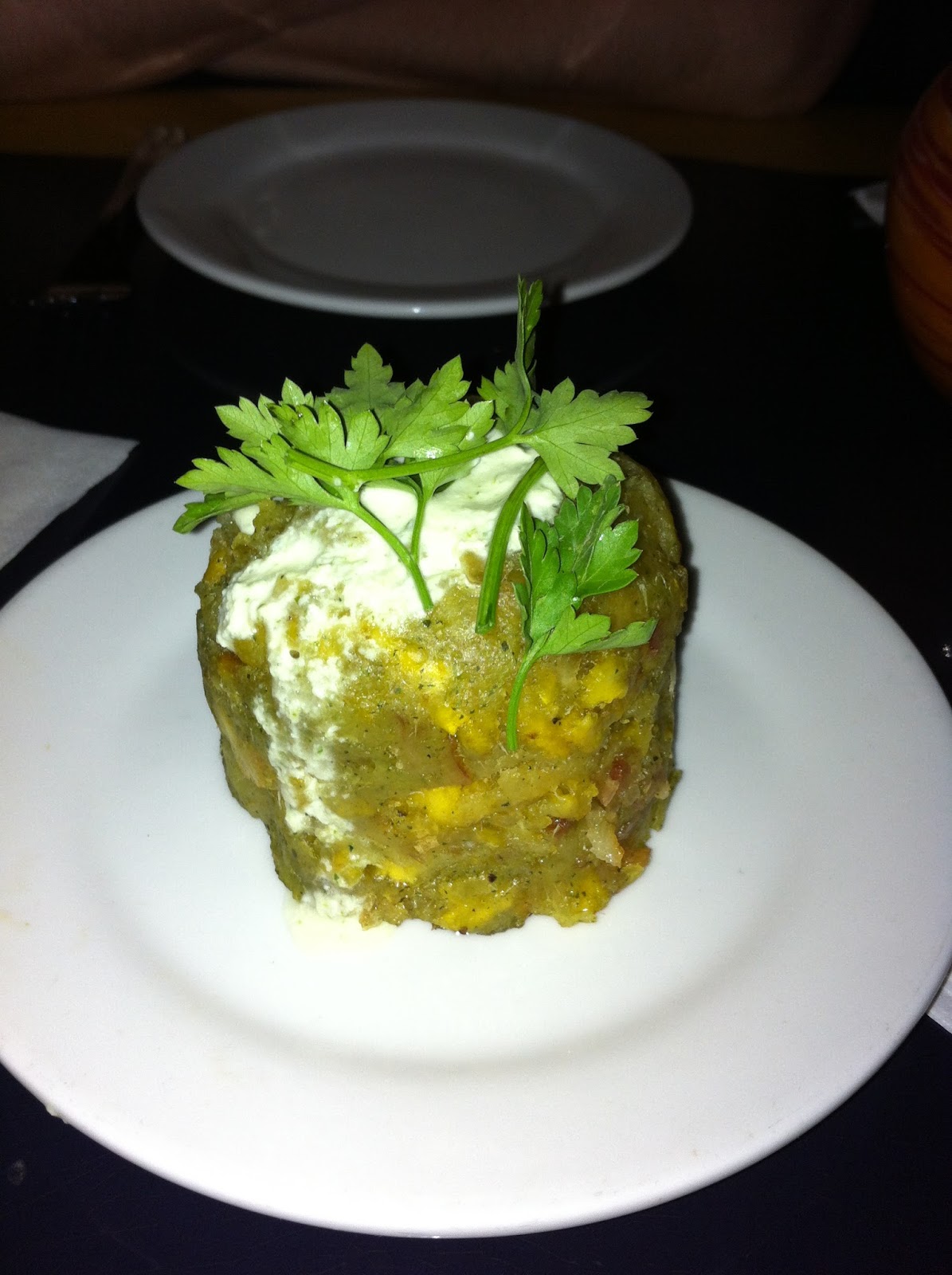
After dessert, we bid Paulina and Gustavo adios and waddled the few steps back to our room for a little afternoon siesta. Of course, when dinnertime rolled around a couple of hours later, we were ready for the evening meal. We took a chance this time and decided to go off-guidebook, following our hotel's recommendation of wandering down Calle Fortaleza to find whatever suited our fancy. Before too long, the Parrot Club, a brightly-decorated Nuevo Latino restaurant beckoned. Neither of us was terribly hungry yet, so we chose to have one of the house sides of mofongo for an appetizer (see photo below).


This appeared to be the real deal mofongo, made from fried plantain and yucca, then mixed with broth, garlic, olive oil, onions (maybe?), and some kind of pork parts (bacon?), awesomely sublime in both taste and texture. I can clearly see how this would be the favorite comfort food of many Puerto Ricans. Unfortunately, my entree wasn't quite up to snuff. Although definitely looking the part (see photo below), my marinated pork tenderloin was actually pretty bland. Even the savory sides of rice, crunchy veggies, and more plantain couldn't stop me from throwing in the towel early.


As it turns out, this meal ended up being the worst dining misstep (albeit a minor one) of our whole trip, as will be documented by the upcoming postings for Days 3 and 4. Stay tuned...

Thursday, September 5, 2013

Puerto Rico Dining - Day 1

With the Norman's celebratory dinner gala (my 10th anniversary gift to the wife) still fresh in memory, the time quickly arrived for Mrs. Hackknife to give me her present for our anniversary, a long weekend in San Juan, Puerto Rico sans kids (my in-laws were kind enough to fly down to Florida to watch the progeny). This trip was originally supposed to be a secret; however, I accidentally discovered her ruse and was then subsequently tasked by her to plan the dining portion of our journey (which, of course, I was more than happy to do). Given that we'd just attended an amazing event where top-level chefs had presented their take on upscale tropical cuisine, I was really excited about now having the opportunity to try similar dishes in their native (read: less pretentious) environment.

JetBlue flew us nonstop from Tampa to San Juan in only 2 1/2 hours, and by the time we checked into our hotel (a converted building that had spent its first 250 years as a convent), we were knee-deep in the colonial confines of Old San Juan seeking our first taste of comida criolla (as the Puerto Ricans call their cuisine). The hotel front desk recommended that we visit El Jibarito (Calle Sol 280) for lunch, located only a few blocks up the hill and down the street.


Open since the mid-1980s, El Jibarito appeared to be popular with locals and tourists alike, resembling the type of place where Hemingway might have popped in for a daiquiri after an afternoon of fishing (of course, the same can probably be said for many establishments in this corner of the world). While comida criolla primarily reflects Spanish heritage, it also draws in influences from the Caribbean, Africa, and the indigenous Taino people that once populated the island. Our appetizer seemed to be straight from the American South, however, a plate of hush puppies that were a little lighter and creamier on the inside than their USA counterparts (the dipping sauce, a mixture of ketchup and mayonnaise, was addictive and is very popular here, as we'd see later).


For my main course, I opted for a pork and plantain tamale that was accompanied by a scoop of yellow rice, washed down with the island's favorite brew (Medalla Light, as mellow and easy-drinking as any hot climate beer I can remember having).


While the tamale was tasty, Mrs. Hackknife's entree was better: a lightly breaded and fried steak (not as heavy as the chicken-fried variety one might find in Texas) served with a fantastic side of mashed plantains, garlic, olive oil, broth, and bacon known as mofongo, one of Puerto Rico's signature dishes. Apparently, the plantain is usually fried before mashing and combining it with the other ingredients, but we weren't sure that this was the case at El Jibarito, possibly calling into question whether or not this was true mofongo or just a healthier variant. In any case, by the time we sampled a small tres leches cake in a foil cup for dessert, we had been amply fortified for a hot and humid afternoon of sightseeing.

Dark clouds and a heavy rainstorm eventually forced us to retreat to our hotel room, where we napped and got ready for our very anticipated dinner later that evening at Pikayo, Chef Wilo Benet's flagship restaurant. A Puerto Rican native, Chef Benet appeared both as a guest judge in the finale of Top Chef Season 4 and as a contestant in the first iteration of Top Chef Masters. Open since 1990, Pikayo allows the chef to showcase his vision for upscale comida criolla, masterly combining beloved local ingredients with luxury touches. Once located in the Puerto Rico Museum of Art, the restaurant now occupies a swanky spot in the Conrad Condado Hotel, only a short cab ride from our hotel. We stopped long enough for Mrs. Hackknife to win a penny from the slot machines in the Conrad's casino (take that, you bums), then entered Pikayo's strikingly white dining room with abstract tropical paintings to add some splashes of color.

Since we're normally suckers for a good tasting menu, we begged off our server's description of a whole fried snapper special in lieu of the evening's set menu, which sounded spectacular (and was only $65 per person to boot, a pretty fair value for 5 courses). First up was a patty of tuna tartare, mixed with minced jalapenos for some heat and topped with briny green roe, all resting in a pool of sweet and cool yuzu miso broth, all the best parts of Japan and the Caribbean in a single concise dish.


Course #2 was likely the best thing I ate all trip and ranks among the best of 2013, a sizable lobe of foie gras atop a ripe fried plantain disc and drizzled with black truffle honey. This was gastronomy of the highest, plate-licking, eyes-rolling-back-into-the-skull order and I did my ultimate best to scrape up every last drop of that black truffle honey with a fork (no easy feat, mind you).


After the shaking stopped, I was pleasantly surprised to find the next plate almost nearly as special, two delicate scallop ravioli paired with crunchy asparagus and a white wine beurre blanc sauce. Upon completion, I immediately wished there were 12 more of these in front of me.


Sadly, my entree (two giant grilled prawns set atop a bed of coconut milk polenta and spicy guava sauce) ended up feeling a bit anticlimactic following the wild success of the last two courses. Although very good, the guava sauce could have used a little more punch to it.


Dessert provided another uplifting experience, a mini cheese souffle (containing manchego, cream cheese, and Parmesan according to our server) paired with a shooter of guava sauce. These two items melded well together and were the perfect conclusion to what had been a standout meal.


Tuesday, September 3, 2013

Norman's 10th Anniversary Gala Dinner


(Left to right - Chefs Emeril Lagasse, Norman Van Aken, and Dean Fearing)


After a bit of recovery time from lunch and a largely unsuccessful birdwatching excursion around the resort property (raindrops threatened to fall nearly the entire time, keeping our avian friends out of sight), the time had arrived for me to squeeze into my monkey suit and saunter over to the Plaza Ballroom for the gala's "Canape and Champagne Reception". Knowing full well that we'd be given a very good glass of wine with each of the upcoming dinner's 8 courses, I limited myself to one flute of bubbly (Taittinger Millesime, Brut Champagne 2005) and gorged on appetizers instead (sadly, there are no photos of these - too hard to eat, drink, and snap pics with only two hands). Chefs James and Julie Petrakis (whose restaurant Cask & Larder we'd only just eaten at a few hours earlier) had prepared two different hors d'oevres for the reception, an ethereal rabbit and foie terrine with pickled vegetable relish on a (very crunchy) rye crostini and what appeared to be a slab of Neapolitan ice cream (which was actually layers of pink cured hamachi and crispy red wine bone marrow) atop a thin cracker. Three more small bites were provided by the executive chef of the Ritz-Carlton Orlando Resort, Sean Woods, namely a deviled quail egg with dill flower (I passed on these while Mrs. Hackknife had a couple, finding them not as good as C&L's deviled eggs from lunchtime), a mighty fine Hudson Valley foie gras croquette with summer fig jam (possibly the best fried item that'd ever crossed my palate), and salmon tataki (i.e., lightly seared) with cauliflower mousse and Osetra caviar. Our hometown Tampa chef (Greg Baker from The Refinery) added one last appetizer, a small cylinder of pickled okra filled with Key West pink shrimp, a chorizo rice cracker, and tomato gravy gelee.

Before long, the doors to the ballroom were thrown open and the dinner guests wandered over to their assigned tables. Following a brief welcome speech by Norm Van Aken, each chef (minus the increasingly schizophrenic Charlie Trotter, who wasn't able to attend the event due to "medical issues", the cynic in me convinced that he just didn't feel like showing up) gave a description of their dish that had been conceived for tonight's meal. First up was a taste of the Yucatan Peninsula from retired megachef Jeremiah Tower (of Chez Panisse fame), who has made his residence there since he grew weary of the high-end restaurant business several years ago.


Chef Tower's dish arrived with three spoons respectively containing raw oyster, salt cod with chimole (an intricate black-colored soup that's native to Mayan cuisine), and something called "Paloma's Kastakan pork belly", which seems to simply mean pork belly cooked medium (Kastakan appears to be a Mayan word meaning "half cooked", although I could be totally wrong on this). In the center was a shooter glass of what was essentially liquid guacamole that we were instructed to sip with each spoon bite. In keeping with the chef's longstanding philosophy of clean, simple preparation and tastes (for all intents and purposes, he is the founding father of this movement in American cookery), all of the protein flavors (fish, etc.) were neatly balanced against the tropical spices and rich avocado. The wine pairing for this course was a Grand Cru white Burgundy, Jean-Marc Brocard Les Clos 2010.

Course #2 was a succulent chunk of Maine lobster, served beside a little jar of Costa Rican hearts of palm salad that was topped with luxurious Siberian caviar (Florida raised in Sarasota), courtesy of Scott Hunnel, a Chicago native that's currently the head chef at the Walt Disney World Victoria & Albert's Restaurant (no doubt the best dining venue in the whole 47 square mile resort, not that that's necessarily saying much). A Napa Valley Sauvignon Blanc (Galerie 2012) was chosen to accompany the lobster/caviar. I noticed quite a bit of silence at our table while this dish was being (presumably happily) consumed.


One of Chef Trotter's stand-ins presented the following plate, a hearty-yet-delicate artichoke soup with hamachi, baby leeks, and saffron aioli. Inventive soups are a Trotter trademark and this one did not disappoint, especially when paired with a white Rhone (Chateau Beaucastel Chateauneuf-du-Pape, 2011) wine.


Chef Emeril's version of surf-and-turf came next, a whole roasted quail that had been stuffed with Florida shrimp and mirliton (a squash-like vegetable, an Emeril favorite, I heard), then topped with a spring onion reduction sauce and a grilled wild mushroom salad. Although tasty, the quail was a little unwieldly, leading many in this well-dressed crowd (including myself) to perform the uncivilized act of using fingers to gnaw quail meat off of its little bones. The consensus from our table was that the wine pairing (a Finca Sandoval "Signo" 2009, made mostly from a lesser-known red grape called Bobal in the Manchuela region of Spain) was better than the dish it accompanied.


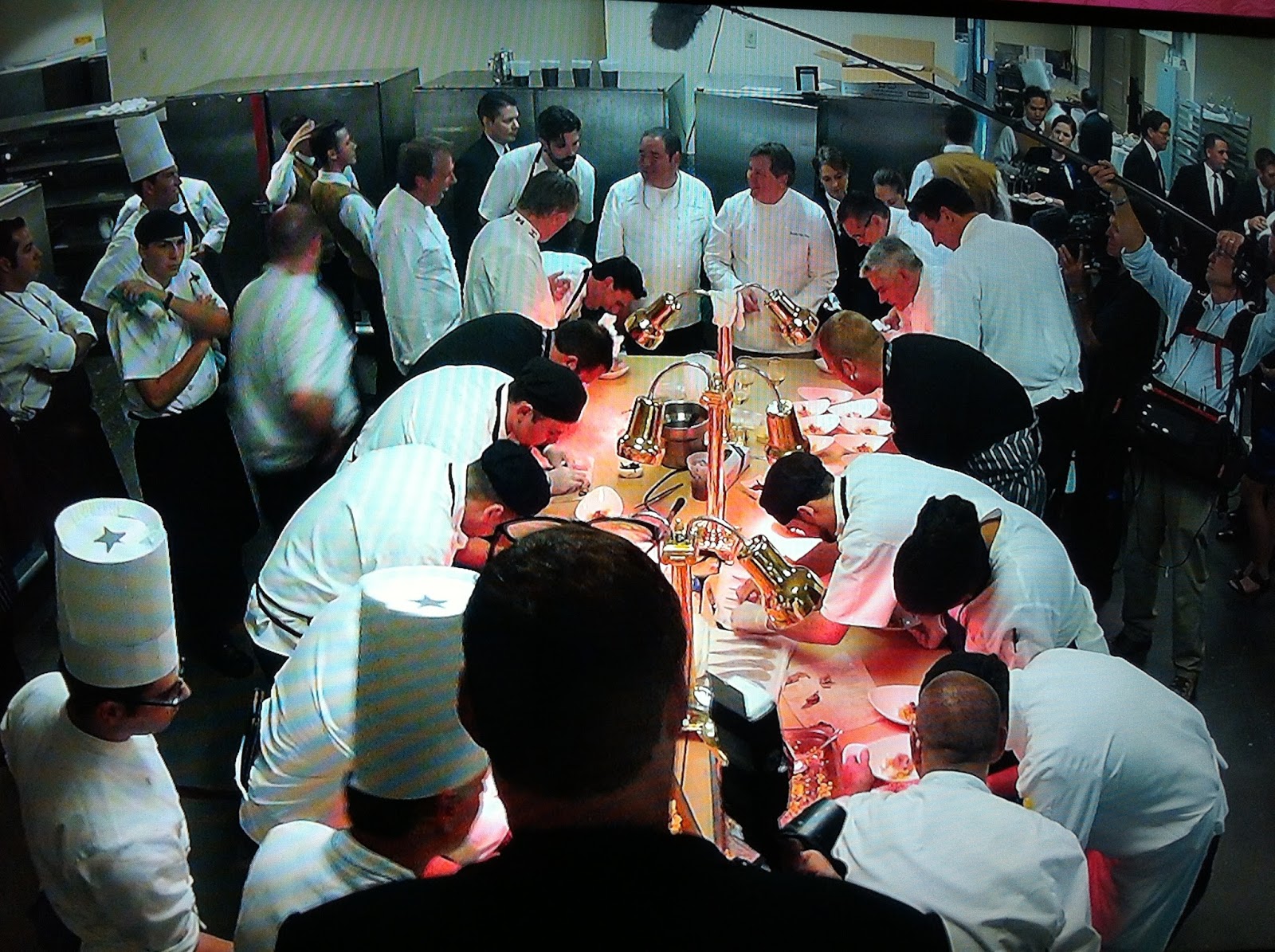
As you might imagine, the kitchen during this time was constantly abuzz with activity, chefs and sous-chefs plating with impunity. Someone had the astute idea of setting up remote video feeds in the dining room for attendees to follow the action, so I took the opportunity to get a photo of the maelstrom between Courses #4 and #5:


Star Orlando Chef Brandon McGlamery (who helms Prato and Luma on Park, two restaurants that are on our hit list) presented his dish next, a tender strip of veal and three veal-stuffed casoncelli (similar to ravioli, except tubular) in a smoked corn broth and topped with gremolata (a chopped herb condiment with parsley, garlic, and lemon zest), summer truffle, and shaved frozen Wagyu beef lardo, white as the driven snow. This plate is inspired by the cuisine of the Lombardy region of north-central Italy and was spectacular. A unique red wine from the same geographical area (Nino Negri Quadrio Valtellina Superiore 2008) was poured with this course, made from Nebbiolo grapes (more commonly found in Barolo) that have been dried for a few months to add a modicum of sweetness to the finished bottle (similar to Amarone).


I was starting to slow down a bit by this point, but the kitchen kept trucking along. The guest of honor (Chef Van Aken) was given the Course #6 slot to showcase his dish, a roasted wreckfish filet topped with a disk of Butifarra sausage (from the Catalonia region of Spain) and caramelized cured foie gras, resting in a pool of veal porto reduction. This was a rich creation that needed a bold wine, in this case a Cabernet Sauvignon from Rudd Winery in Napa (Samantha's 2008).


Amazingly, things just got better and better. The Dallas-based Chef Dean Fearing (who, unbeknownst to me, was running the kitchen at the Mansion on Turtle Creek when I had one of my very first fine dining experiences there in 1996) prepared a knockout maple-soaked buffalo tenderloin, fork-tender and served with a chile-braised rabbit enchilada, fiesta salad, and green/red salsas. As good as the buffalo was, I would have shoved bamboo sticks under my fingernails to get a full plate of the rabbit enchiladas, with each bite teetering on the razor's edge between tolerable and uncomfortable spicy heat. A very nice Tuscan red (Casanova di Neri, Tenuta Nova Riserva 2008, Brunello di Montalcino) dampened the buzz from the chiles.


Finally, we had reached the dessert portion of our evening. The Ritz-Carlton Orlando pastry chef Stephane Cheramy presented a beautiful and innovative (if not absolutely delicious) plate containing Manjari chocolate (from Madagascar), a coconut water-lemongrass sorbet, and flax seeds nougatine for some texture. I was hard pressed to come up with a better meal ending that I'd had in recent memory (the wine selected to go with this dish was a sweet Domaine Philippe Delesvaux "Saint Aubin" Selection de Grains Noble 1997 from the Coteaux du Layon appellation of the Loire Valley).


Just in case the main dessert wasn't sufficient, Chef Cheramy also prepared gift boxes of macarons for the attendees to bring home (varieties included avocado lemon, white truffle, blueberry, yuzu wasabi grapefruit, and smoked chocolate tea). Unfortunately, the macarons didn't fare too well in the Florida humidity (pretty crumbly after a day), but the unique flavors still shined through (especially my favorite, the white truffle).


And just like that, it was over. Despite being ephemeral (as all meals are, great or otherwise), the missus and I had the sense of having attended a momentous culinary occasion that highlighted the very best that our new homeland had to offer. When taking into account this weekend and the weekend to follow (when Mrs. Hackknife and I immersed ourselves in Puerto Rican cuisine - many postings to come), there was no question that we'd created for ourselves an anniversary to remember...

Tuesday, August 27, 2013

Primo/Cask & Larder


With our 10th wedding anniversary fast approaching, I completely stumbled across the perfect gift for Mrs. Hackknife while perusing Twitter one afternoon:


The chef providing the tweet is Greg Baker of Tampa's Refinery (a great place that I wrote about in April) and "this man" is referring to Norman Van Aken, whose generally known as the godfather of fusion cuisine; that is, one of the first to incorporate the flavors/styles of Latin America and Caribbean food into American dishes (as you might expect, given its geographic location, Florida has been a longtime base for Chef Norm's endeavors). The event that Chef Baker alludes to in his posting is the 10th Anniversary Food & Wine Gala for Norman's Restaurant at the Ritz-Carlton resort in Orlando, a once-in-a-lifetime gathering of such gastronomic luminaries as Jeremiah Tower, Charlie Trotter, Emeril Lagasse, and Dean Fearing, all of whom have been contemporaries of Chef Norm and have also made their own indelible marks on the fine dining world as we know it today. A who's-who of prominent younger chefs and sommeliers from Central Florida were invited to participate in the gala as well, the centerpiece of which was a black tie dinner (open to the public) where each of the chefs contributed a course. With my mind sufficiently blown, I feverishly began to determine whether or not I could turn this opportunity into the ideal anniversary gift; fortunately, at this late stage, I was able to get 2 tickets (not cheap, but they included two free nights at the resort) and somehow arrange for a babysitter to watch the progeny over the weekend, so off we went.

The main writeup for the fantasy gala feast will be in my next posting - of course, we had to eat a few other meals during our weekend in Orlando, two of which were noteworthy enough to warrant their own blog entry. First up was Primo, Chef Melissa Kelly's Mediterranean-leaning farm-to-table venture in the J.W. Marriott resort (located next door to the Ritz). One of the people we met at the gala's welcome reception on Friday evening (Judge Jim from Tampa) recommended Primo as a good place to grab dinner following a few cocktails. With no other commitments that night, we wandered over to the Marriott and were seated at Primo in short order. Chef Kelly actually has another Primo in Tucson and the original flagship location in Rockland, Maine, which was prominently featured in a 2010 episode of No Reservations (I recall seeing the episode, but didn't make the connection between this restaurant and the Rockland one until after we got home). Oblivious to her background, we happily dug into the following amuse bouche of a seared whitefish nugget paired with a single brown gnoccho:


Feeling a little lubricated from the welcome reception and always cursed with eyes larger than our stomachs, we made no hesitation in ordering 2 appetizers and 2 entrees, the first of which was a spectacular dish consisting of what appeared to be two grilled calamari tubes, each stuffed with sticky squid ink risotto and topped with a spicy red pepper sauce, plus a few fried calamari rings:


Our second starter, veal shank ravioli with demi-glace, grilled pear, and a dollop of white cream (burrata?), was good, but overshined by the two-way calamari:


Nearly as fantastic as the calamari dish was my entree, a sauteed scaloppine of pork saltimbocca, sitting atop a bed of roasted garlic mashed potatoes, spinach, and prosciutto, all covered in a decadent sage-mushroom Madeira jus (my apologies for the lousy photo):


Our second entree was again just a step behind the first, a duck breast (which was a little tough) with pickled peaches, Florida peach butter, porcini mushrooms, and baby carrots/turnips:


Although mighty full by this point (and not realizing just how full until about 2:15 later that night when I awoke to angry noises from my mid-section), we had to indulge in a little tres leches cake for dessert:


By the next morning, food was the furthest thing from my mind as I struggled to get through my bowl of granola and yogurt at the breakfast table. By the time we arrived in Winter Park (a nearby suburb of Orlando) to do a little window shopping, however, I could actually conceive of having a meal for lunch that wouldn't be nursing home fodder. Fortunately, this was the appropriate digestive state for our lunchtime destination, Cask & Larder, billed as a "Southern Public House" serving inventive snacks and goodies cobbled together from fine ingredients throughout the Southeast. Chefs James and Julie Petrakis kicked off this trend in Central Florida with their first restaurant (called The Ravenous Pig) and have carried it over to C&L along with a microbrewery this time to make things a bit more intriguing. And while I wasn't aware that I was already going to sample cuisine from this dynamic duo later that evening at the Norman's gala (they were asked to provide some of the hors d'oeuvres during the pre-dinner cocktail hour), the missus and I were pleased to pop in.


Given the excesses of both the night past and the night to follow, we opted to keep our choices limited to a couple of shared plates and accompanying adult beverages. This included the following order of pimiento cheese fries (topped with pickled gypsy peppers and scallions) and a house Bloody Mary for Mrs. Hackknife:


I'm not normally a fan of curly fries, but I would chow down on these every day and twice on Sundays. I can now also speak to the magical curative properties of cured meat, pickled vegetables, and craft beer (in this case, a glass of C&L's Olde Southern Red Wit, a Belgian White with coriander and lime/lemon/grapefruit zest) as we dug into the Southern Picnic (see photo below):


This tray consisted of deviled eggs (which I happily left for Mrs. Hackknife), country ham slices, two discs of crispy pork terrine, aged provolone cheese, and pickled carrots, eggplant, and green beans. By the time we finished, I actually felt better than I had all morning and was ready to take on whatever outrageous, high-society concoctions awaited us later that evening...


Monday, August 12, 2013

Grilled Chicken with Garlic-Herb Dressing

I may have finally discovered what grilling aficionados have known all along: chicken cooks up on the grill pretty darn well. Those of you who are regular readers of this blog are aware of my past difficulties with poultry; that is, I rarely seem to properly prepare it, pulling it out of the oven either undercooked or dried out. Add this to the fact that Mrs. Hackknife is on record telling me that chicken just doesn't do much for her as an entree and it's no wonder that I tend to shy away from making chicken dishes here in the Canteen. One tiny part of me, however, was always curious if the grill might be a superior tool for prepping a bird; so, now that I'm the proud owner of a sizable outdoor kitchen, I had no more excuses to avoid grilling a chicken. After a little bit of digging through the library, I found a simple recipe for grilled chicken with garlic-herb dressing courtesy of Tyler Florence's Ultimate Cookbook and decided to give it a whirl. The recipe also includes grilled lemon and radicchio as garnish, but I decided to omit those and focus solely on the bird.

The first part of the process was preparing the dressing or marinade to be placed on the chicken pieces during grilling. This entailed roasting a head of garlic sprinkled with thyme leaves, then pureeing the softened garlic cloves with olive oil, lemon juice, and parsley to make "a thick vinaigrette" as Tyler calls it (note - if you run out of lemon juice, as I did, the dressing works equally well if you sub in lime juice). Next, you coat the chicken pieces with salt, pepper, and olive oil, putting them skin-side down on a medium-high oiled grill (oiling is important to prevent sticking, although I have to say the stickage wasn't as bad as if I were cooking fish out there) for about 20 minutes. Once flipped over, you baste the pieces with your dressing (I had quite a bit left over, which came in handy as a sauce for the cooked chicken at the table) and cook it for about 20 minutes more until the inner meat temperature reaches 160F.


What you see above is what departed my grill - the chicken was nicely crisped on the outside with a moist/juicy interior (and, perhaps most importantly, cooked all the way through on the first attempt!). The dressing was a little bit robust for the kids, but they ate the parts of the meat unadulterated by sauce, while the missus and I swooned over the end product. This recipe is definitely one for the regular rotation and, all of a sudden, I feel like I have some chicken mojo finally working for me, a convenient thing considering the latest issue of Food & Wine covers almost exclusively chicken (deep-fried chicken livers, anyone?)...